Morocco · Road
By Triumph Adventure Spain · 9 min read · Morocco, Atlas, Sahara
Morocco is 35 minutes from Spain by ferry. But the moment you cross the Strait of Gibraltar and leave Tangier behind, the landscape, the pace and the scale of everything around you change so radically that it is hard to believe you are still this close to home. The High Atlas rises above 4,000 metres. The dunes of Erg Chebbi stretch for 22 kilometres. The walls of the Todra Gorge drop vertically 300 metres on either side of the road. A motorcycle tour in Morocco is not just another trip — it is the one that changes you.
📍 Málaga to Tangier: 35 min by ferry · High Atlas: up to 4,167m · Best season: March–May and September–November
The destination
Why Morocco is the most remarkable motorcycle destination near Europe
Most riders who visit Morocco for the first time are not prepared for the scale of what they find. Morocco is not a small country — it is roughly the size of Spain, with a geographical diversity that no other Mediterranean destination can match in such a short distance.
In eight days of riding you can leave Málaga by ferry, cross the cedar-forested Rif Mountains, drop into the blue city of Chefchaouen, thread through the Middle Atlas to Fez — the imperial city with 9,000 streets in its medieval medina — head south through the Dadès and Todra gorges, reach the Sahara at Merzouga, cross the High Atlas on the Tichka pass at 2,260 metres and finish in Marrakech. And you will still have left half the country unseen.
Chefchaouen — the blue city
Fez — 9,000 medieval streets
Dadès & Todra gorges
Erg Chebbi — Sahara dunes
High Atlas — up to 4,167m
Marrakech
Casablanca
The roads
The most spectacular motorcycle routes in Morocco
The Rif Mountains and Chefchaouen
The road from Tangier leads straight into the Rif Mountains — a chain of cedar and pine-forested peaks running along the Mediterranean coast. Rif roads are narrow, technical and almost traffic-free on weekdays. Chefchaouen, perched in a gorge at 600 metres, is the kind of place that looks invented: a maze of blue-and-white painted streets unlike anything you will have ridden to before.
⛰️ Rif Mountains · Max altitude: 2,456m · Chefchaouen: 600m · ~300km from Tangier
The Middle Atlas and Fez

From Chefchaouen, the route to Fez cuts through the Middle Atlas — cedar forests, mountain lakes and Berber villages where the road winds for kilometres without a straight in sight. Fez is the oldest of Morocco’s four imperial cities. Its medieval medina, a UNESCO World Heritage site, has over 9,000 streets with no access for motor vehicles. Parking the bike and walking in is mandatory — and worth every minute.
The Dadès and Todra gorges

South of the High Atlas, the Dadès Gorge is the most photographed stretch of road in Morocco: a series of hairpin turns climbing a red-rock canyon so tight that riders call them the “smile curves”. The Todra Gorge, a few kilometres to the east, is even more dramatic — vertical walls 300 metres high narrowing until there is barely room for the road and the river below.
⛰️ Todra Gorge · 300m walls · Dadès Gorge · Red-rock canyon with hairpin bends
The Erg Chebbi desert

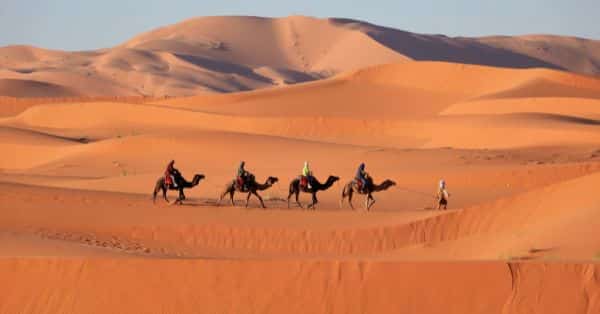
The Erg Chebbi desert, near Merzouga in southeastern Morocco, is the moment riders remember most. The dunes reach 150 metres and stretch 22 kilometres long by 5 kilometres wide. The road that runs along the western edge is straight, fast and completely surreal — perfect tarmac with the Sahara on one side and the Atlas on the horizon. At sunset, the colour of the sand shifts from orange to red to purple in minutes.
🏜️ Erg Chebbi · Dunes up to 150m · 22km long · Merzouga, southeastern Morocco
The High Atlas: Tichka pass

The Tizi n’Tichka connects Ouarzazate to Marrakech through the heart of the High Atlas. At 2,260 metres, it is the highest road pass in Morocco. The climb from the south follows the Dadès valley past mud-brick kasbahs some of them over a thousand years old. The descent to Marrakech is technical and long — over 100 kilometres of continuous downhill with the city skyline slowly coming into view.
⛰️ Tizi n’Tichka · 2,260m · Morocco’s highest road pass · Ouarzazate → Marrakech
When to go
The best time for a motorcycle tour in Morocco
|
🟢 Spring (March–May) The best window of the year. Mountain temperatures between 15–25°C. The desert is warm but not extreme. Atlas passes are open and roads are in their best condition after winter. |
🟢 Autumn (September–November) Second-best option. Atlas temperatures drop after the summer heat. The October light in the desert is extraordinary. Fewer tourists and roads almost empty midweek. |
|
🔴 Summer (June–August) Not recommended for the full route. Desert temperatures exceed 45°C. The north and mountains are cooler, but riding south in full gear becomes genuinely demanding. |
🟡 Winter (December–February) High Atlas passes can close due to snow. The north and coast remain rideable. Not recommended for the full route if it includes the desert and mountain passes. |
What you need to know
Five things every rider should know before going to Morocco
1. The riding style is different
Morocco has its own unwritten rules of the road. Overtaking is frequent and verges are not always clear. In city medinas, traffic is chaotic by design — the streets were never built for motorised vehicles. Outside the cities, however, national roads are well maintained and traffic drops away dramatically. Morocco rewards the rider who gets off the main routes.
2. Documentation for crossing with your own bike

To enter Morocco with your own motorcycle you need a Carnet de Passages en Douane — a customs document guaranteeing the bike will leave the country. European riders can obtain it through their national motoring clubs (in the UK, through the RAC or AA; in Spain, through the RACE). Processing can take several weeks, so apply well in advance. If you hire a bike from us, we handle all vehicle paperwork.
3. Ferries from Spain
There are several ferry options from Spain to Morocco. The fastest is Tarifa–Tanger Med: 35 minutes, multiple operators, bikes carried without issue. From Algeciras there are also ferries to Tangier and Ceuta. Almería and Motril run overnight ferries to Nador — a useful option if you want to enter northern Morocco directly and avoid Tangier. On guided tours, the ferry crossing is typically included in the price.
4. Language and money
Arabic and Berber (Tamazight) are the official languages, but French is widely spoken in cities and in the tourism industry. Spanish has a presence in the north, near Ceuta and Melilla. The currency is the Moroccan dirham (MAD) — it is not convertible outside the country, so change money on arrival. Cards work at higher-end hotels and restaurants, but cash is essential in the south and in smaller towns.
5. The hospitality
Morocco has one of the most genuine hospitality cultures in the world. On the roads through the south and in Atlas villages, it is common for strangers to invite you in for tea without knowing you at all. Riders who have done the tour mention it consistently as the most memorable part of the trip — more so than the gorges or the dunes.
“Every day the landscape is completely different. That just does not happen anywhere I have ridden in Europe. And the people — the people make you feel genuinely welcome in every single village.”
— Guest rider, Triumph Rewards of Morocco Tour 2025
The guided tour
Triumph Rewards of Morocco Tour: Málaga to the Sahara and back in 8 days

Our guided road tour covers approximately 2,000 kilometres in 8 days departing from Málaga. The route runs from the Spanish Mediterranean coast to the Sahara and back, taking in Chefchaouen, Fez, the Dadès gorges, the desert at Rissani, Ouarzazate, Marrakech and Casablanca. VIP hotels at every stage, a support van throughout, 2 official Triumph instructors and full insurance are all included. Maximum 12 riders per edition.

🏍️ 8 days · ~2,000km · 100% tarmac · Departs Málaga · From €2,730/person · Max 12 riders · Own bike welcome
New 2027 dates — Limited places
Triumph Rewards of Morocco Tour

📅 26–27 March 2027
📅 9–16 October 2027
Málaga → Chefchaouen → Fez → Dadès → Rissani → Marrakech → Casablanca → Tangier → Málaga · VIP hotels · Support van · 2 Triumph instructors · From €2,730
FAQ
Frequently asked questions about motorcycle touring in Morocco
How many days do you need for a motorcycle tour in Morocco?
To cover the full route — north (Chefchaouen, Fez), south (Dadès, Todra, desert) and return via Marrakech — a minimum of 8 riding days is recommended, plus ferry days. Our Triumph Rewards of Morocco Tour covers approximately 2,000km in 8 days departing and returning to Málaga, with the ferry crossing included in both directions.
What is the best time of year for a motorcycle tour in Morocco?
Spring (March–May) and autumn (September–November) are the optimal windows. Mountain temperatures sit between 15 and 25°C, Atlas passes are open and roads are in their best condition. Summer temperatures in the desert exceed 45°C — not advisable for the full route in full riding gear.
What documents do I need to ride my own motorcycle into Morocco?
In addition to your passport, driving licence and insurance with Morocco cover, you will need a Carnet de Passages en Douane if you are bringing your own bike. This document guarantees the motorcycle will leave the country and is issued through national motoring clubs (RAC or AA in the UK, RACE in Spain). Processing can take several weeks. If you hire a bike from us, we handle all vehicle documentation.
Is Morocco safe for motorcycle touring?
Yes, with the right preparation. National and regional roads are well maintained. City riding requires attention and a degree of adaptation to local style. On a guided tour, the instructors know the routes in detail, the support van accompanies the group throughout and groups are capped at 12 riders so no one gets left behind.
Can I ride my own motorcycle on the Triumph Rewards of Morocco Tour?
Yes. The road tour welcomes riders on their own bikes. If you plan to bring your own, you will need to arrange the Carnet de Passages in advance — confirm this at the time of booking and we will advise you through the process. Bear in mind that once you factor in the ferry cost and wear on your bike, hiring one of our Triumph motorcycles (under six months old) often works out comparable in price.
What level of experience is required for the Morocco road tour?
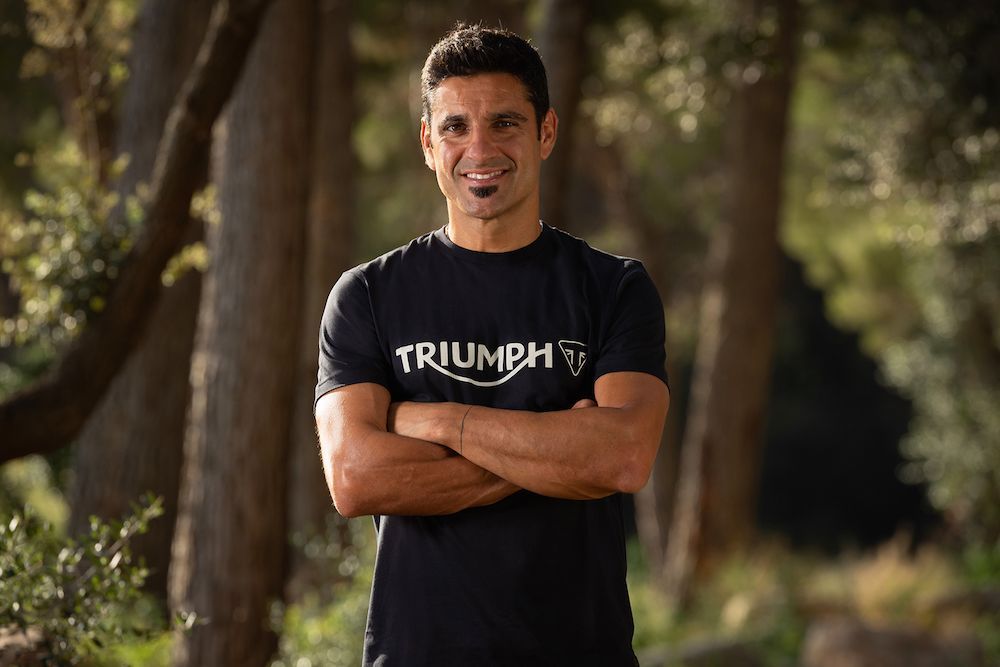
The Triumph Rewards of Morocco Tour is 100% tarmac — no dirt tracks, no off-road sections. We recommend a minimum of two years’ riding experience and confidence completing daily stages of 200–300km. If you are looking for off-road terrain, we also run the Triumph Rewards of Morocco Enduro Tour on the TF 450 E, guided by Iván Cervantes, 5-time Enduro World Champion.
What is the difference between the road tour and the enduro tour?
The road tour covers approximately 2,000km in 8 days on tarmac, visiting the main cities and landscapes of the country. The enduro tour covers 3,000km in 9 days with around 50% off-road terrain — desert pistes, Atlas crossings, technical ground. The enduro requires prior off-road experience and uses bikes from our fleet (Triumph TF 450 E). The road tour accepts your own motorcycle.